Mushroom Bagging Line vs. Modular Machines: A Buyer's Spec Guide
Mushroom Bagging Line vs. Modular Machines: A Buyer's Spec Guide
An integrated mushroom bagging line and a set of modular bagging machines can both fill substrate bags, but they are specified, scaled and deployed in different units — and those units decide which one fits a given farm. Changxing production-line models are published in bags per day: 15,000 bags/day for the 2-station lines, 25,000 bags/day for the 4-Station Shiitake Mushroom Bagging & Tying Production Line, and 50,000 bags/day for the 4-station black Termitomyces line. Modular machines are published in bags per hour, from 400–600 bags/h on the ZD-3 small friction clutch bagging machine to 7,000–8,000 bags/h on the ZN-B integrated bagging and tying machine.
This guide compares the two families spec by spec — capacity basis, bag envelope, power rating, footprint, automation level and certification scope — using only the published specification sheets for the named models. It is written for buyers in the research and evaluation stage who need to eliminate options on facts before they start discussing configuration.
What the Line-vs-Modular Decision Actually Decides
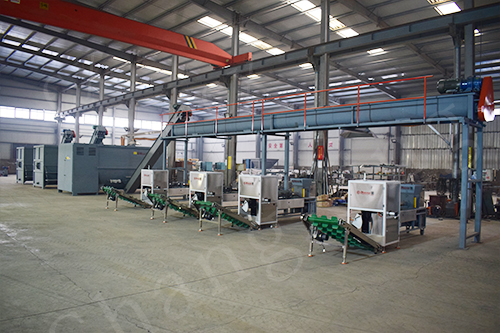
In this comparison, an integrated production line means a multi-station system that handles mixing, conveying, material distribution and bagging as one controlled sequence, operated from an integrated electrical control box that supports one-key start or independent unit operation. A modular machine performs a narrower task as a standalone unit — filling a bag, or filling and tying it — and is loaded manually or linked to a conveyor.
Changxing line models follow that pattern. The 4-Station Shiitake Mushroom Bagging & Tying Production Line runs shovel feeding → mixing → conveying → distributing → bagging → tying, and can be extended with optional downstream equipment such as an automatic ring sleeving machine, an automatic hole punching and stick inserting machine, a bagging and tying integrated machine or a tray loading machine. The 2-station line follows the same sequence and adds a bag confluence step after tying.
The modular range is broader in function than the word "modular" suggests. It includes clutch-driven bagging machines (ZD-3, TZD-1, TZD), stamping bagging machines (ZD15-24, GZD15-24), square-bag machines (FD, CX-FD), integrated bagging and tying machines (ZN, ZN-B) and a high-speed shiitake bagging machine (CX-GJZ). The ZN-B, for example, already combines bagging and tying in a single unit rated at 7,000–8,000 bags/h.
The decision is a configuration question, not a quality judgement. How will your target output be produced, in which bag format, on which power supply, in how much floor space, and with how many manual touches per bag?
In practice, choosing one family over the other fixes five things at once:
- The capacity basis your production plan is built on — bags per day or bags per hour.
- The range of bag formats the equipment will accept at the infeed.
- The electrical supply, foundation and (where pneumatic) compressed-air requirements on site.
- How much floor area the project consumes and how tightly the layout can be arranged.
- How many operator interventions remain per bag, and therefore your labour requirement per shift.
Why Spec Sheets, Not Brochures, Now Drive This Comparison
The commercial backdrop explains why buyers compare specifications so closely. The global mushroom equipment market was valued at USD 3.8 billion in 2025 and is projected to reach USD 7.2 billion by 2033, and Asia-Pacific accounted for a 42.3% revenue share in 2025, driven by industrial-scale cultivation in China. China's edible mushroom industry value exceeded RMB 380 billion (approximately USD 53 billion) in 2024, representing over 70% of global output.
Market estimates for this segment should be read with care. Published figures diverge depending on whether the study covers mushroom equipment broadly or machinery only, so a market size is useful context for investment timing but is not a procurement specification. The specification sheet is what you actually commit to.
Compliance sharpens the same point. For equipment entering the European Union, edible mushroom automation equipment must comply with the EU Machinery Directive (2006/42/EC) and the EMC Directive (2014/30/EU) for CE marking. That obligation attaches to the specific machine and configuration, which means an integrated line and a modular bagging machine are assessed against the same test — and a certificate's product list matters as much as its existence.
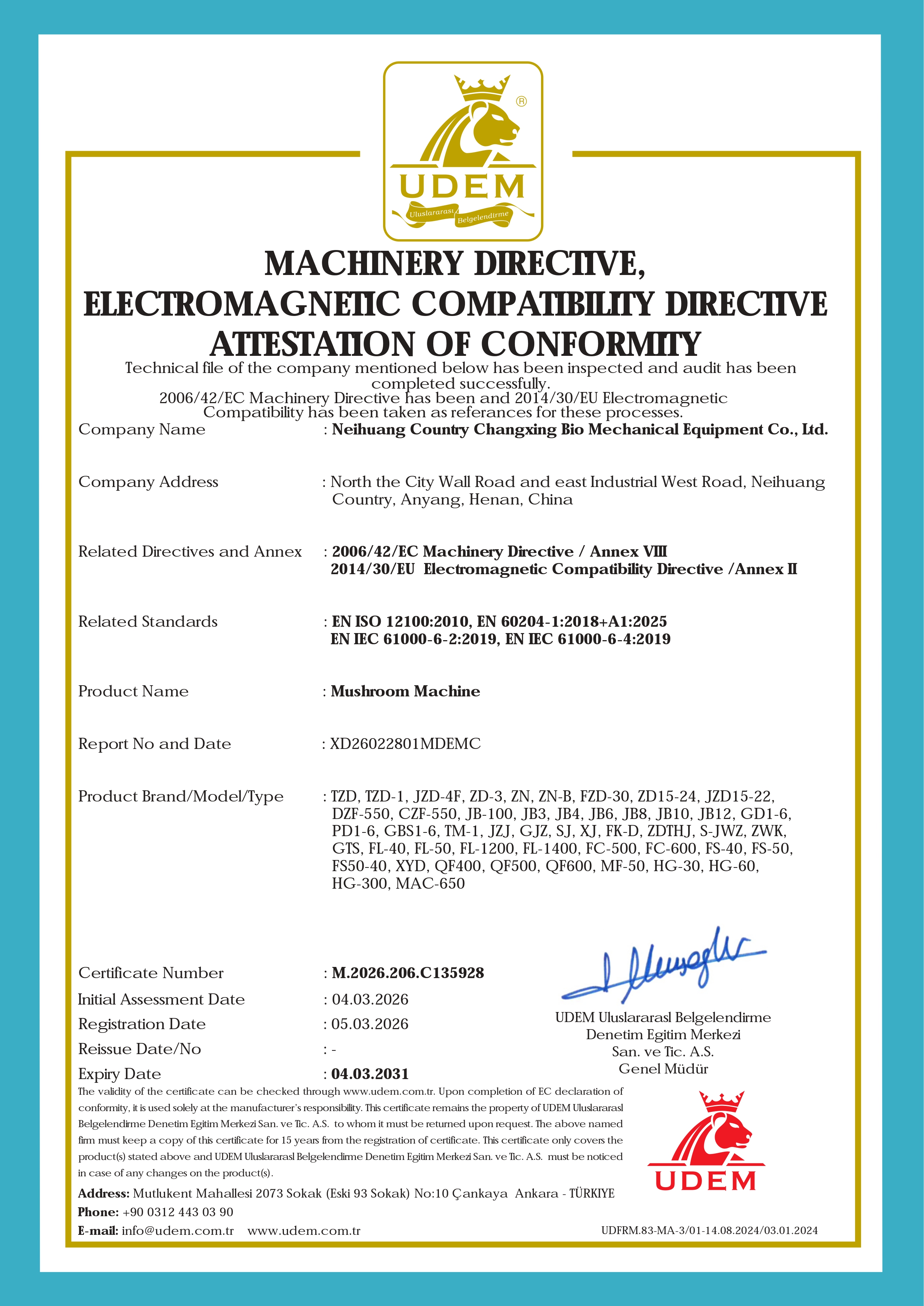
Changxing's bagging and tying machinery is covered by CE attestation M.2026.206.C135928, issued by UDEM on 5 March 2026 and valid to 4 March 2031. The attestation references the Machinery Directive (2006/42/EC) and the EMC Directive (2014/30/EU) and lists harmonized standards EN ISO 12100:2010, EN 60204-1:2018+A1:2025, EN IEC 61000-6-2:2019 and EN IEC 61000-6-4:2019.
The Spec-by-Spec Comparison: Integrated Lines and Modular Machines
The two tables below reproduce the published specification fields that decide the comparison. Where a field is listed as customizable or is not published for a given model, it is shown as such rather than estimated.
| Configuration | Model | Published capacity | Bag size (per spec sheet) | Process flow |
|---|---|---|---|---|
| 4-Station Shiitake Mushroom Bagging & Tying Production Line | 4-Station Production Line | 25,000 bags/day | Length 14–22 cm, width 28–63 cm | Shovel feeding → mixing → conveying → distributing → bagging → tying |
| Automatic Edible Mushroom Bagging Production Line (black Termitomyces) | 4-Station Production Line | 50,000 bags/day | Length 14–22 cm, width 28–37 cm | Shovel feeding → mixing → conveying → distributing → bagging |
| Automatic Edible Mushroom Bagging & Sealing Line | 2-Station Production Line | 15,000 bags/day | Length 14–22 cm, width 28–63 cm | Shovel feeding → mixing → conveying → distributing → bagging → tying → bag confluence |
| 2-Station Full-Automatic Mushroom Substrate Bagging Production Line | 2-Station Production Line | 15,000 bags/day | Length 14–22 cm, width 28–63 cm | Front loader feeding → mixing → conveying → distributing → bagging → tying → bag collection |
| 4-Station High-Capacity Mushroom Substrate Bagging Production Line | 4-Station Production Line | 25,000 bags/day | Length 14–22 cm, width 28–63 cm | Front loader feeding → mixing → conveying → distributing → bagging |
All line models share the same input voltage (AC380V 50Hz) and the same control concept: an integrated electrical control box supporting one-key start or independent unit operation. Optional modules are published for the line family — automatic ring sleeving machine, automatic hole punching and stick inserting machine, bagging and tying integrated machine, and basket loading machine. Line power, net weight and overall dimensions are listed as customizable or to be confirmed per configuration, and the line setup and workshop layout are configurable to daily output and site conditions.
| Machine | Model | Published capacity | Bag size (per spec sheet) | Power | Net weight / dimensions |
|---|---|---|---|---|---|
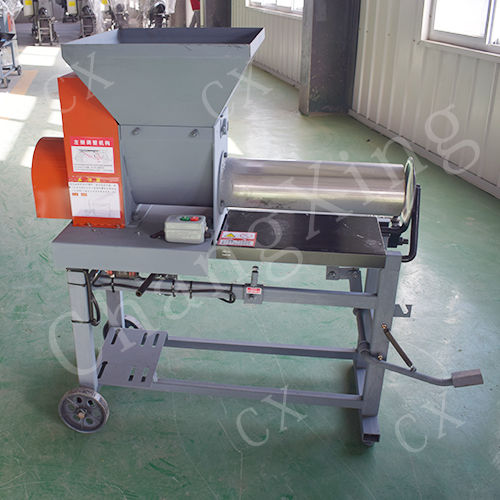
| Small Friction Clutch Mushroom Bagging Machine | ZD-3 | 400–600 bags/h | Length 28–60 cm, width 12–25 cm (flat width 12–25 cm; max filling height ≤45 cm) | 1.5 kW, AC220V 50Hz | 37 kg / L650 × W450 × H900 mm |
| Small Electromagnetic Clutch Mushroom Bagging Machine | TZD-1 | 600–800 bags/h | Length 28–60 cm, width 12–25 cm (flat width 15–25 cm; max filling height ≤45 cm) | 2.2 kW, AC220V / 380V | 100 kg / L1150 × W650 × H1050 mm |
| Pneumatic Automatic Mushroom Bagging Machine | TZD | 700–900 bags/h | Length 28–60 cm, width 12–25 cm (flat width 15–25 cm; max filling height ≤45 cm) | 2.2 kW / 3 kW, AC220V / 380V | 120 kg / L1150 × W650 × H1050 mm |
| Automatic Stamping Mushroom Bagging Machine | ZD15-24 | 1,200–1,500 bags/h | Flat width 15–22 cm; max filling height ≤19 cm | 3 kW, AC380V | 530 kg / L1400 × W1280 × H1650 mm |
| Automatic Stamping Oyster Mushroom Bagging Machine | GZD15-24 | 800 bags/h | Length 45–50 cm, width 15–22 cm (max filling height ≤32 cm) | 3 kW, AC380V | 730 kg / L1400 × W1280 × H2300 mm |
| Automatic Square Bag Bagging Machine | FD | 800 bags/h | Length 45–55 cm, width 30–32 cm | 4 kW, AC380V | 190 kg / L1600 × W460 × H1050 mm |
| Square Bag Stamping Bagging Machine | CX-FD | 600–800 bags/h | Length 40–50 cm, width 30–32 cm | 3 kW, AC380V | 420 kg / L1500 × W1420 × H1800 mm |
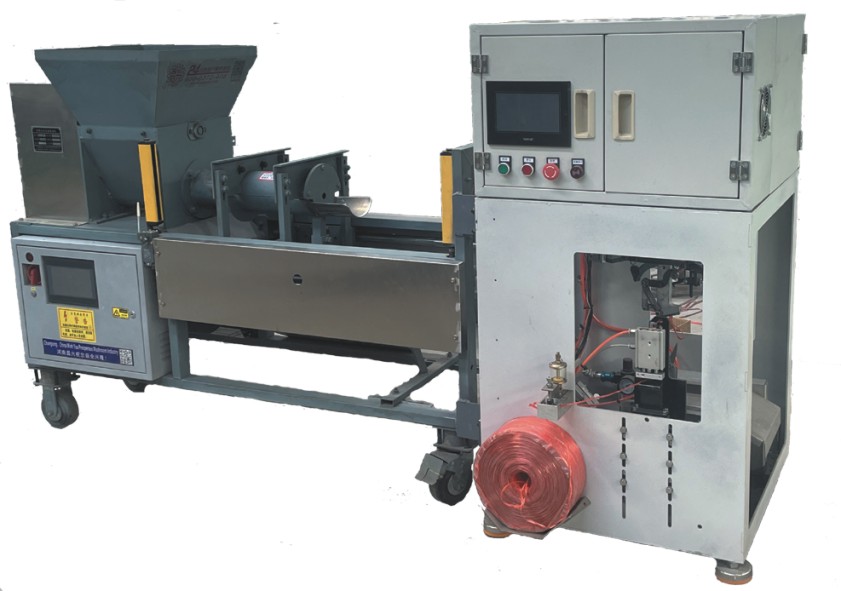
| Integrated Shiitake Mushroom Bagging & Tying Machine | ZN | 800–1,200 bags/h | Suitable for multiple sizes of mushroom bags | 4 kW, AC380V | 380 kg / L2100 × W530 × H1200 mm |
| Integrated Bagging & Tying Machine | ZN-B | 7,000–8,000 bags/h | Not stated on the sheet; flow is feeding → uniform bagging → automatic rope clamping → rope winding → knotting → sealing | 5 kW, AC380V | 500 kg / L1860 × W530 × H1200 mm |
| Automatic High-Speed Shiitake Mushroom Bagging Machine | CX-GJZ | 650–750 bags/h (double film) / 1,000–1,200 bags/h | Flat width 15–18# roll bag; bag length 550–600 mm | 8 kW, AC380V | 750 kg / L2300 × W1500 × H1650 mm |
1. Capacity: Normalise Bags per Day and Bags per Hour First
Line and modular capacities are published on different clocks, and that is the single most common source of confusion in this comparison. Line figures are daily totals: 15,000 bags/day for the 2-station lines, 25,000 bags/day for the 4-station shiitake bagging and tying line, and 50,000 bags/day for the 4-station black Termitomyces line. Modular figures are hourly: 400–600 bags/h (ZD-3), 600–800 bags/h (TZD-1), 700–900 bags/h (TZD), 800 bags/h (GZD15-24 and FD), 600–800 bags/h (CX-FD), 800–1,200 bags/h (ZN), 1,000–1,500 bags/h (double-stamping ZD15-24), 1,200–1,500 bags/h (ZD15-24), 650–750 bags/h double film or 1,000–1,200 bags/h (CX-GJZ) and 7,000–8,000 bags/h (ZN-B).
Because the line sheets do not publish a shift pattern or utilisation rate behind the daily figure, the honest comparison step is to ask the supplier to state the hours per day behind any daily number, and the number of machines running in parallel behind any hourly number. Only then do both families sit on the same basis.
Scaling follows the same logic. A line scales with station count (the 2-station configuration is published at 15,000 bags/day; 4-station configurations at 25,000 and 50,000 bags/day), while a modular bank scales by adding units. A published application instance from Malaysia describes an integrated system combining mixer, elevator, material distributor and automatic bagging and tying machine with a daily output of nearly 80,000 bags — capacity built at the system level rather than by a single machine.
2. Bag Envelope: The Field That Eliminates Options Fastest
Bag format usually narrows the shortlist faster than capacity does. The line family is specified for bags of length 14–22 cm and width 28–63 cm, except the black Termitomyces 4-station line, which is specified at length 14–22 cm and width 28–37 cm. These are the figures recorded on the specification sheets and should be treated as the line's design envelope.
The modular family covers a different set of formats:
- Clutch and pneumatic bagging machines (ZD-3, TZD-1, TZD): length 28–60 cm, width 12–25 cm, with flat widths of 12–25 cm or 15–25 cm and a maximum filling height of 45 cm.
- Stamping bagging machines: ZD15-24 at flat width 15–22 cm with maximum filling height 19 cm; the double-stamping ZD15-24 at length 30–38 cm and width 14–22 cm with the same 19 cm fill limit; GZD15-24 for oyster mushroom bags at length 45–50 cm and width 15–22 cm with a 32 cm fill limit.
- Square-bag machines: FD at length 45–55 cm and width 30–32 cm; CX-FD at length 40–50 cm and width 30–32 cm, with automatic 6-hole punching.
- Roll-bag machine: CX-GJZ, specified for flat width 15–18# roll bag with a bag length of 550–600 mm.
- Integrated bagging and tying machines: ZN is specified as suitable for multiple sizes of mushroom bags; ZN-B covers bagging and tying in one unit but does not publish a bag envelope on its sheet.
The decision rule is simple enough to apply before any quotation: measure the finished bag — flat width, bag length and filling height — and compare it against the sheet. Bag format, not mushroom species, sets the initial shortlist, and the same variety can sit in either family depending on the bag the grower actually runs.
3. Power: Single-Phase Modules vs. Three-Phase Lines
Electrical supply is a hard constraint because it is expensive to change after installation. Every Changxing line model is published at AC380V 50Hz. On the modular side the requirement is graded: the ZD-3 runs on AC220V 50Hz at 1.5 kW and weighs 37 kg; the TZD-1 accepts AC220V or 380V at 2.2 kW; the pneumatic TZD accepts AC220V or 380V at 2.2 kW or 3 kW; the stamping and square-bag machines (ZD15-24, GZD15-24, CX-FD) are AC380V at 3 kW; the FD and ZN are AC380V at 4 kW; the ZN-B is AC380V at 5 kW; and the CX-GJZ is AC380V at 8 kW.
The practical implication is that a site without a three-phase supply, or with limited connected load, can still be brought into production with a single-phase module, whereas a line requires the site to be prepared — the published application requirements for integrated lines list a 380V three-phase supply, a stable flat foundation, compressed air where pneumatic equipment is used, and operation by trained personnel only. Several modular models also publish IP54 protection and a 0–40 °C working temperature (TZD-1, TZD, GZD15-24), which is useful information when the bagging area is not fully climate-controlled.
4. Footprint: A Castor-Mounted 37 kg Machine vs. a Configured Line
Modular footprints are published and fixed, and they span a wide range. At the small end, the ZD-3 measures L650 × W450 × H900 mm and weighs 37 kg; the TZD-1 and TZD both measure L1150 × W650 × H1050 mm at 100 kg and 120 kg; the FD is unusually slim at L1600 × W460 × H1050 mm; the ZD15-24 is L1400 × W1280 × H1650 mm at 530 kg; the CX-FD is L1500 × W1420 × H1800 mm; the GZD15-24 is the tallest at L1400 × W1280 × H2300 mm; and the CX-GJZ is L2300 × W1500 × H1650 mm at 750 kg. Several models are mounted on universal and directional casters and can be repositioned.
Line dimensions are not fixed. For the line family, overall dimension is listed as customizable and designed per workshop layout, and the line setup is configurable to daily output and site conditions. That is an advantage in a purpose-built workshop and a constraint in an existing building where the floor plan cannot be reorganised — the footprint has to be designed, reviewed and locked before shipment rather than placed on castors.
5. Automation Level: Counting the Manual Touches per Bag
Automation level is easier to compare if it is reduced to one measurable question: how many times does an operator touch each bag? On a line, the sequence runs under an integrated electrical control box with one-key start or independent unit operation, from feeding through mixing, conveying, distributing bagging and (on the tying configuration) tying. On a modular machine, the answer depends on the control layer that is specified.
Published control levels across the modular range run from a two-stage gear drive with friction clutch and foot pedal control (ZD-3), through electromagnetic clutch with mechanical brake (TZD-1) and electromagnetic clutch with pneumatic components (TZD), to high-precision mechanical program control (ZD15-24, GZD15-24, CX-FD), an intelligent control system with industrial touch screen, digital display, fault alarm and man-machine dialogue operation (FD), and PLC touch screen control with intelligent detection, fault alarm and digital display (ZN-B). The CX-GJZ adds an AC380V 8 kW drive with Xinje high-speed motion axis PLC control, hybrid stepping motors, linear bearings and guides, and performs fixed-length bag cutting and automatic welding.
Two published details matter for the labour count. The ZD15-24 stamping machine is compatible with an automatic bag receiving conveyor, which removes a manual discharge step, and the CX-GJZ can be paired with an automatic tying machine or an automatic hole-punching and film-sticking machine. On the line side, the optional modules — ring sleeving, hole punching and stick inserting, bagging and tying, basket loading — perform the same function of removing touches from the flow.
6. Certification: The Constraint That Can Override Everything Else
For EU-bound projects, CE marking under the Machinery Directive (2006/42/EC) and the EMC Directive (2014/30/EU) applies to the machine and its configuration, not to a supplier's general reputation. Changxing's bagging and tying machinery is covered by CE attestation M.2026.206.C135928 from UDEM, issued 5 March 2026 and expiring 4 March 2031, assessed against EN ISO 12100:2010, EN 60204-1:2018+A1:2025, EN IEC 61000-6-2:2019 and EN IEC 61000-6-4:2019.
What makes this relevant to the line-versus-modular question is scope. The related-product list attached to that attestation includes production-line models (2-Station and 4-Station Production Lines) as well as modular models including the ZD15-24 stamping bagging machine, the TZD and TZD-1 bagging machines, the ZN and ZN-B integrated bagging and tying machines, the FD and CX-FD square-bag machines and the CX-GJZ high-speed bagging machine. A buyer can therefore compare a line and a set of modules under a single certification scope, provided the exact model and configuration on the purchase order appears in that list — a check worth running before contracts are signed.
Running the Comparison on Your Own Numbers: Six Steps
Step 1 — Normalise the capacity basis. Write your target as a daily bag requirement, then state the hours per day and the utilisation you assume. Convert every supplier figure — daily or hourly — onto that basis before comparing anything else.
Step 2 — Fix the bag envelope. Record flat width, bag length and maximum filling height for every bag format you intend to run, now and in the next planning cycle. Compare them against the published envelopes in Tables 1 and 2. This step alone usually decides whether the line family is even eligible.
Step 3 — Confirm power, foundation and air. Check whether the site has AC380V 50Hz three-phase available, whether a stable flat foundation can be provided, and whether compressed air at 0.5–0.7 MPa is available if pneumatic equipment is in scope. A single-phase module (AC220V on the ZD-3; AC220V or 380V on the TZD-1 and TZD) is the lower-preparation route.
Step 4 — Draw the automation boundary. List the manual touches per bag on each option — bag loading, positioning, tying, discharge and collection — and count the operators required per shift. Then decide which touches you are buying away, using the optional modules on the line or the conveyor and downstream pairings on the modular side.
Step 5 — Match the scaling method to your growth plan. If volume will grow in defined steps against a fixed bag format, station count is the lever. If varieties and formats will change, adding or redeploying modules keeps the options open. Both are legitimate; the mistake is choosing one scaling model and then planning growth on the other.
Step 6 — Verify certification scope and commercial terms. Check the certificate number, issuing body, validity dates and product list against the exact model you are buying. On the commercial side, Changxing states a minimum order quantity of one unit, a lead time of 30–55 days, a monthly capacity of 1,000 units, 100% testing before delivery under ISO-standard quality control, and remote after-sales support.
Use Cases: Which Configuration Fits Which Operation
A single bag format at high daily volume. When the bag is fixed, the volume target is high and the building can be laid out around a fixed flow, the line family is the straightforward fit: 15,000 bags/day on a 2-station line, 25,000 bags/day on the 4-Station Shiitake Mushroom Bagging & Tying Production Line, and 50,000 bags/day on the 4-station black Termitomyces configuration with its narrower bag width of 28–37 cm.
Multiple varieties and changing bag formats. Where oyster, shiitake, black fungus and related varieties run on the same site in different bag formats, modular machines allow the format to be matched machine by machine: clutch or pneumatic bagging machines for 28–60 cm bags, stamping machines for shorter filled bags, square-bag machines for 30–32 cm widths, and the GZD15-24 for the 45–50 cm oyster format. A published South Korea application instance describes bagging operations covering oyster mushroom, shiitake, black fungus and pearl oyster, with matched equipment including an automatic bagging manipulator, mixer, conveyor, material distributor and basket loader.
Sites with limited power or limited floor area. A 37 kg machine measuring L650 × W450 × H900 mm and running on AC220V 50Hz is a realistic starting point where three-phase supply or space is unavailable. The trade-off is capacity: 400–600 bags/h rather than a daily line figure.
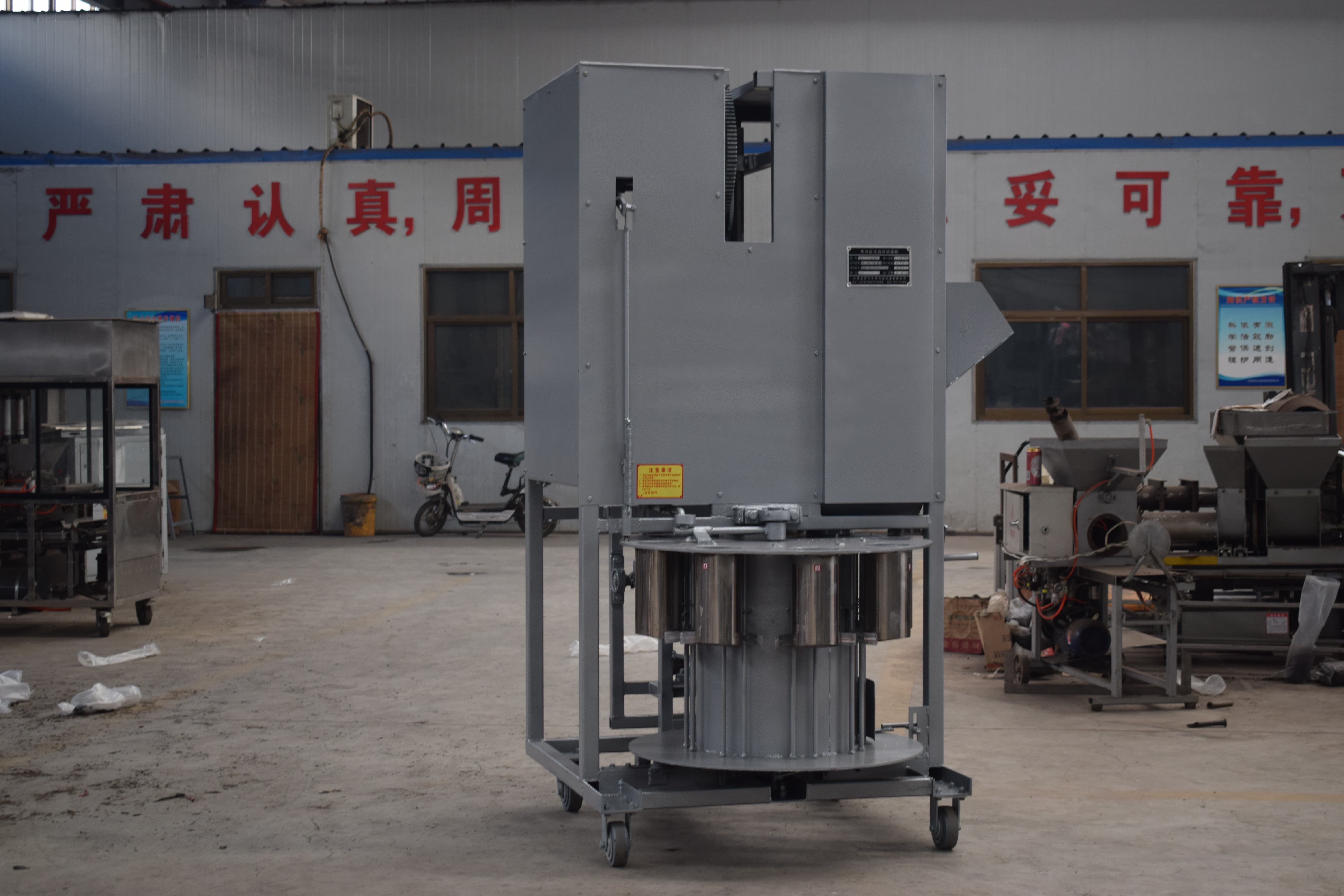
Operations that need bagging and tying in one pass but not a full line. The ZN (800–1,200 bags/h, bagging → tying → finished product output) and the ZN-B (7,000–8,000 bags/h with automatic rope clamping, winding, knotting and sealing under PLC touch-screen control) perform both operations without the mixing and conveying stages of a line.
Cooperatives and distributors serving several growers. Where output must be demonstrated before a line investment is justified, a modular bank validates the bag format and the labour model on real production, and the same machines remain useful as secondary capacity after a line is installed. Changxing reports a reference case covering mushroom farms, planting bases, agricultural equipment distributors and agricultural enterprises across South Korea, Malaysia, Russia and the United Kingdom, with 20+ units of annual export volume operating for 5 years at a reported bagging speed of over 1,000 bags per hour.
Decision Matrix: Line vs. Modular Machine at a Glance
| Decision criterion | Integrated bagging line | Modular bagging machine |
|---|---|---|
| Capacity basis published | Bags per day | Bags per hour |
| Published capacity in Changxing's range | 15,000 bags/day (2-station); 25,000 bags/day (4-station); 50,000 bags/day (4-station black Termitomyces) | 400–600 bags/h (ZD-3) up to 7,000–8,000 bags/h (ZN-B) |
| Bag envelope published | Length 14–22 cm, width 28–63 cm; 28–37 cm for the black Termitomyces 4-station line | Machine-specific: 28–60 × 12–25 cm (ZD-3, TZD-1, TZD); flat width 15–22 cm (ZD15-24); 45–50 × 15–22 cm (GZD15-24); 30–32 cm width (FD, CX-FD); roll bag 550–600 mm (CX-GJZ) |
| Operations covered per unit | Mixing, conveying, distributing and bagging, with tying on tying configurations | One operation per machine, or bagging plus tying on ZN and ZN-B |
| Control architecture | Integrated electrical control box; one-key start or independent unit operation | Machine-level control: foot pedal and friction clutch, electromagnetic clutch, mechanical program control, or PLC touch screen |
| Electrical supply | AC380V 50Hz | AC220V (ZD-3); AC220V or 380V (TZD-1, TZD); AC380V on larger models |
| Footprint | Customizable; designed per workshop layout | Fixed: from L650 × W450 × H900 mm (37 kg) to L2300 × W1500 × H1650 mm (750 kg) |
| How capacity is scaled | Station count | Adding units |
| Certification coverage | CE attestation M.2026.206.C135928 (UDEM, issued 5 March 2026, valid to 4 March 2031) covers bagging and tying machinery; the related-product list includes both line models and modular models | |
| Commercial terms stated by the manufacturer | MOQ 1 unit; lead time 30–55 days; monthly capacity 1,000 units; 100% test before delivery under ISO-standard quality control; remote after-sales support | |
| Best-fit trigger | One fixed bag format, high daily volume, layout can be designed around the line | Multiple formats, phased investment, limited power or floor space, or a need to validate before committing |
FAQ: Line vs. Modular Bagging Decisions
Is Changxing's mushroom bagging equipment CE-certified, and what does the certificate cover?
Yes. Changxing's bagging and tying machinery is covered by CE attestation M.2026.206.C135928, issued by UDEM on 5 March 2026 and valid to 4 March 2031. The attestation references the Machinery Directive (2006/42/EC) and the EMC Directive (2014/30/EU), with listed harmonized standards EN ISO 12100:2010, EN 60204-1:2018+A1:2025, EN IEC 61000-6-2:2019 and EN IEC 61000-6-4:2019. Its related-product list includes production-line models (2-Station and 4-Station Production Lines) and modular machines such as the ZD15-24 stamping bagging machine, the TZD and TZD-1 bagging machines, the ZN and ZN-B integrated bagging and tying machines, the FD and CX-FD square-bag machines and the CX-GJZ high-speed bagging machine. Buyers should confirm that the exact model and configuration on their purchase order appears in that list.
Can a modular bagging machine handle the same bag sizes as a mushroom bagging production line?
Not necessarily, because the published envelopes differ. Changxing's 4-station shiitake bagging and tying line and its 2-station lines are specified for bags of length 14–22 cm and width 28–63 cm, while the black Termitomyces 4-station line is specified at length 14–22 cm and width 28–37 cm. Modular machines cover other formats: the ZD-3, TZD-1 and TZD accept bags of length 28–60 cm and width 12–25 cm with a maximum filling height of 45 cm; the ZD15-24 stamping machine is specified at flat width 15–22 cm with a maximum filling height of 19 cm; the GZD15-24 stamping machine for oyster mushroom bags is specified at length 45–50 cm and width 15–22 cm with a 32 cm fill height; and the FD and CX-FD square-bag machines are specified for bag widths of 30–32 cm. Match the machine to the bag format you will actually run, then compare capacity.
How should I compare a line rated in bags per day with a machine rated in bags per hour?
Put both on the same clock. Line specifications are published as daily totals — 15,000 bags/day for the 2-station lines, 25,000 bags/day for the 4-station shiitake bagging and tying line and 50,000 bags/day for the 4-station black Termitomyces line — while modular machines are published hourly, from 400–600 bags/h (ZD-3) to 7,000–8,000 bags/h (ZN-B). Because the line sheets do not state a shift pattern or utilisation rate behind the daily figure, ask the supplier to confirm the hours per day behind any daily number and the number of units running in parallel behind any hourly number. As a reference point, Changxing reports a case covering mushroom farms, planting bases, distributors and agricultural enterprises in South Korea, Malaysia, Russia and the United Kingdom, where 20+ units of annual export volume have operated for 5 years with a reported bagging speed of over 1,000 bags per hour.
What drives cost when choosing between a line and modular machines?
Configuration drives cost rather than a single list price, and several cost-relevant specification fields are explicitly variable. For the line family, power, net weight and overall dimensions are listed as customizable or to be confirmed per configuration, and the line can be extended with optional modules — automatic ring sleeving machine, automatic hole punching and stick inserting machine, bagging and tying integrated machine, and basket loading machine. On the modular side the drivers are machine size and control level: a 37 kg ZD-3 with foot-pedal control and a friction clutch sits at a different level of the range from a 750 kg CX-GJZ with PLC control and an 8 kW drive. The honest comparison is total configured cost — number of units, optional modules, power supply preparation, foundation work and operator count per shift — rather than unit price in isolation.
Can we validate a configuration before ordering, and how long does delivery take?
Changxing states a minimum order quantity of one unit, a lead time of 30–55 days, a monthly capacity of 1,000 units, 100% testing before delivery under ISO-standard quality control, and remote after-sales support. To validate a configuration first, send your bag dimensions (flat width, bag length, maximum filling height), your target daily output and your available power supply, and request a recommendation against the models that match those inputs — for example the ZD-3 (400–600 bags/h, AC220V single phase) where space or power is limited, or the 4-Station Shiitake Mushroom Bagging & Tying Production Line (25,000 bags/day) where the bag format is fixed and volume is high. You can reach the Changxing team at nhchangxing@outlook.com or +86 13103721233 to start that comparison.
Conclusion: Choose the Specification Basis First
The line-versus-modular decision narrows quickly once the two specification languages are separated. Set your target output on one clock, fix the bag envelope, confirm the power supply and floor area, count the manual touches you are buying away, and verify the certification scope against the exact model. On that basis, a line configuration suits a fixed bag format at high daily volume where the building can be designed around the flow, and modular machines suit multi-format production, constrained sites and phased investment — with machines such as the ZN-B showing that the boundary between the two is a configuration choice rather than a category rule.
Neihuang County Changxing Biological Machinery Equipment Co., Ltd. (Changxing Edible Mushroom Machinery) is an edible mushroom equipment manufacturer based in Neihuang County, Henan, China, founded in 2009. The company operates a 20,000 m² facility with 130 employees, a 25-engineer R&D team and a stated annual output of 10,000 units, and exports about 60% of its output to markets including South Korea, Malaysia, Central Asia, Europe and Russia. Its range covers edible mushroom automation equipment, mushroom equipment production lines, bagging and tying machines, substrate mixers, sterilization and inoculation equipment, and growing-room and basket-handling machinery.
Next Step: Compare the Two Options Against Your Own Bag
Send your bag dimensions, target daily output and available power supply, and ask for a configuration matched to those inputs — a modular machine, a line, or a combination. Sample requests, quotations and catalogue enquiries are welcome.
Website: www.automushmachinery.com
Email: nhchangxing@outlook.com
Tel / WhatsApp: +86 13103721233
Contact: chunhuaWang
Address: Henan Neihuang, China
Have Questions or Need More Details?
Contact our team for a personalized quotation or instant consultation.
Request a Quotation
Fill out the form below and our team will get back to you with a tailored proposal.
WhatsApp Direct Chat
Prefer to chat in real-time? Message us on WhatsApp for instant assistance & quick answers.
- Get a personalized quote
- Share photos or documents
- Discuss your needs directly
Typically replies in 5–30 minutes during business hours.