From Compost to Bagged Substrate: An Application Guide for Streamlined Mushroom Farm Workflow
A mushroom farm's output is largely decided before a single bag reaches the sterilizer. This application guide follows the material path in order — raw material size reduction, screening, mixing, bagging, sterilization, inoculation, and basket loading — and shows how the Changxing Edible Mushroom Machinery equipment set fits into each stage. Every specification quoted below comes from the manufacturer's published product data.
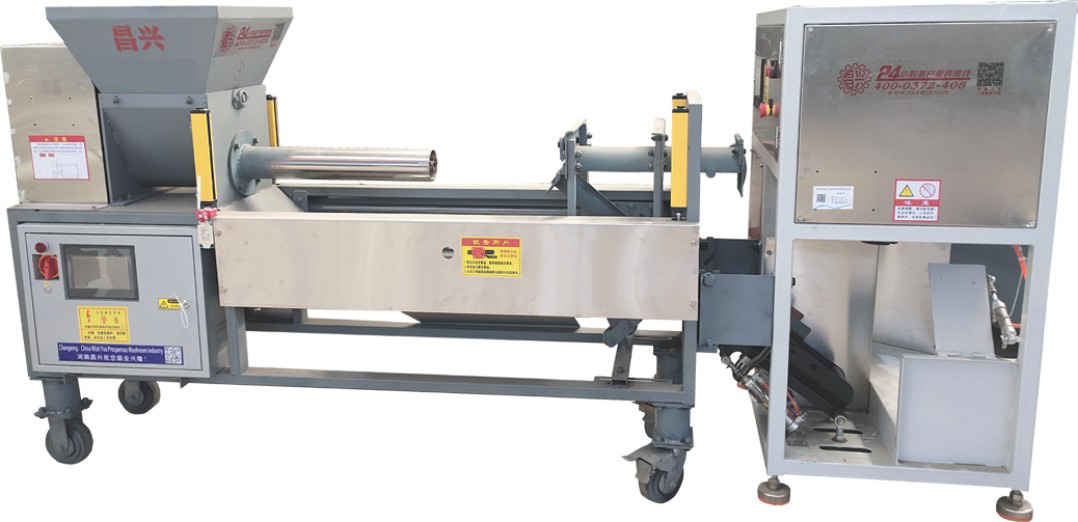
What This Workflow Guide Covers
This is an application guide, not a catalogue. It treats the mushroom farm as a single continuous flow of material and asks one question at each stage: what happens to the substrate here, and what does the equipment have to get right for the next stage to work?
The stages covered are:
- Raw material size reduction — corn cob, log, branch, and cotton material crushing
- Screening and impurity removal
- Substrate mixing
- Bagging and tying
- Sterilization
- Inoculation
- Ring sleeving, capping, basket loading, and nesting
- Outbound shelving and spent-bag recycling
The reference equipment set belongs to Neihuang County Changxing Biological Machinery Equipment Co., Ltd., which trades as Changxing Edible Mushroom Machinery — a Chinese manufacturer of edible mushroom automation equipment established in 2009, operating a 20,000 m² facility in Neihuang County, Henan.
Problem Definition: Where Mushroom Farm Workflows Actually Break
When a farm loses throughput, the first suspect is usually the bagging machine. In most cases the machine is not the cause. The problem arrives with the substrate.
Particle size inconsistency propagates downstream
If corn cob or wood chips leave the crusher with a wide particle spread, the bagged substrate does not have a uniform density. Loose pockets and dense pockets behave differently under steam, and they behave differently for mycelium. Crusher screen aperture is the single most controllable variable here, and it is also the one most often left at whatever was installed at the factory.
Manual bagging creates weight and shape variation
Hand-filled bags vary in both weight and fill height. That variation shows up later as unstable baskets, uneven colonization, and a higher rejection rate during handling. It also makes it impossible to plan downstream capacity with any precision.
Mixing inconsistency hides until fruiting
A mixer that leaves dead zones in the bin produces a batch where nutrient distribution is not uniform. The defect is invisible at bagging and only becomes visible as uneven fruiting across a batch.
The open-bag window between bagging and inoculation
Every bag sits open between the moment it is filled and the moment it is sealed or inoculated. Shortening that window — or eliminating it entirely — is a contamination-control decision as much as a throughput decision.
Industry Background
Mushroom cultivation has been shifting from shed-scale growing toward industrial, continuous-operation facilities for well over a decade, and the equipment market has moved with it.
According to Dataintelo, the global mushroom equipment market was valued at USD 3.8 billion in 2025 and is projected to reach USD 7.2 billion by 2033. The same source places Asia-Pacific at a 42.3% revenue share in 2025, driven largely by industrial-scale cultivation in China. China's edible mushroom industry value exceeded 380 billion yuan — approximately USD 53 billion — in 2024, representing over 70% of global output, as reported by People's Daily citing the Ministry of Agriculture.
What these figures describe at farm level is a shift in what buyers expect from equipment. A crusher is no longer judged only on its motor rating; it is judged on whether the particle size it produces will still be consistent on the ten-thousandth bag. A bagging machine is judged on bag-to-bag repeatability, not on peak speed. And a production line is judged on how few manual hand-offs remain between the raw material pile and the incubation room.
Detailed Solution: A Full Substrate Workflow from One Equipment Set
Changxing Edible Mushroom Machinery builds equipment across the whole substrate chain rather than in isolated categories. The published portfolio covers crushers, screens, mixers, bagging machines, tying machines, inoculation machines, basket handling machines, sterilization cabinets, and downstream logistics units.
The company's operating profile is relevant to how the equipment is specified: a 20,000 m² manufacturing facility, approximately 130 staff including a 25-engineer R&D team, an annual production capacity of roughly 10,000 units, and an export share of about 60%. Its stated export markets include South Korea, Malaysia, Central Asia, Europe, and Russia. The company's stated manufacturing focus includes edible mushroom automation equipment, intelligent edible mushroom equipment, mushroom spawn bag making machines, industrial mushroom sterilization equipment, mushroom bag tying machines, shiitake/oyster mushroom bagging machines, mushroom compost bagging machines, semi-automatic mushroom bag filling machines, automatic mushroom baggers, mushroom substrate bag filling machines, mushroom processing equipment, automatic mushroom production lines, and mushroom substrate mixers.
What follows is how that equipment set maps onto a working farm flow, stage by stage.
Step-by-Step Breakdown of the Substrate Workflow
Step 1 — Raw material size reduction
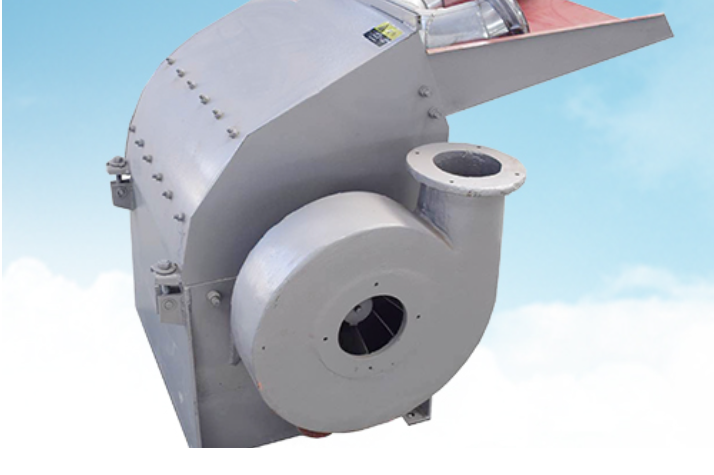
Size reduction sets the ceiling on everything downstream. The Changxing crusher range is split by input material rather than by motor size, which matters because corn cob, hardwood logs, branches, and cotton material behave very differently inside a crushing chamber.
- Large-Scale Corn Cob Crusher (FS60-50) — 30 kW, AC380V 50Hz, capacity 2 tons/h, net weight 210 kg, overall dimension 1500 × 980 × 980 mm. It accepts corn cob, corn stalk, and bean stalk, uses a hammer piece design for one-step crushing, and carries a replaceable screen with 6–20 mm aperture. Process flow: feeding → crushing → discharging. Electric motor or diesel engine drive is available as an option.
- 500-Type Wood Crusher (QF500) — 22 kW, AC380V 50Hz, capacity 1 ton/h, net weight 160 kg, overall dimension 900 × 730 × 880 mm. Suitable for mixed wood and logs up to φ 140 mm, with a replaceable 8–20 mm screen and a knife disc plus hammer piece structure for one-step slicing and crushing. Electric motor or diesel engine drive is available as an option.
- Branch & Cotton Material Crusher (MF-50) — 5.5 kW, AC380V 50Hz, capacity 2500 kg/h, net weight 190 kg, overall dimension 1300 × 620 × 700 mm. It handles tree branches up to φ 30 mm, cotton material, and wood, and produces 3–5 mm flake particles. The knife wheel design uses fixed and moving blades set at low clearance specifically to avoid fiber tangling.
- Mushroom Log Chipper & Grinder (QF400) — a log-oriented unit intended for the agriculture, edible mushroom cultivation, and wood processing industries.
The practical selection rule: match the aperture to the mushroom variety and the bag format, not to the raw material alone. A 6 mm screen and a 20 mm screen on the same FS60-50 produce substrates that behave differently under pressure filling.
Step 2 — Screening and impurity removal
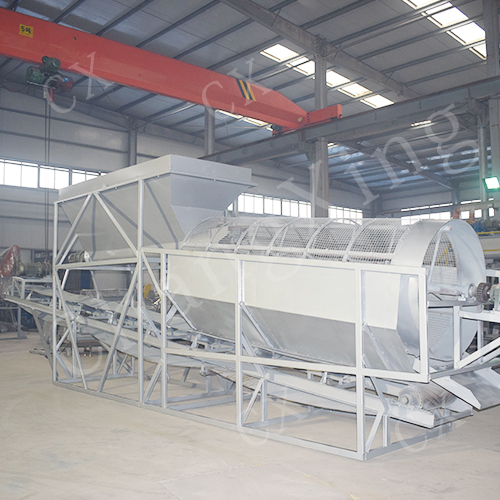
Crushers produce the right particle size and the wrong inclusions. Stones, metal fragments, and oversized chips that survive crushing will damage augers, block bagging sleeves, and end up inside finished bags.
The Large-Scale Rotary Trommel Screen (GTS) is positioned upstream of mixing for exactly this purpose. It runs at 7.5 kW on AC380V 50Hz, with a capacity of 8 tons/h and a net weight of 1200 kg. The overall dimension is 10000 × 1450 × 3000 mm. Its construction combines a heavy-duty drum screen with an industrial conveyor belt, and it uses a front-end loader feeding design aimed at efficient stone and impurity removal. Process flow: feeding → screening → output. It accepts wood chips, corn cob, and granular raw materials.
Step 3 — Substrate mixing

Mixing is where the recipe becomes real. The 100-Type Raw Material Mixer (CXJB-100) is rated at 4 kW on AC380V 50Hz, with a capacity of 0.8 T suitable for corn cob, wheat bran, wood chips, and similar materials. Net weight is 480 kg and the overall dimension is 2290 × 1080 × 1191 mm.
Two structural details matter for consistency. First, the drive uses a motor plus reducer arrangement to bring the motor speed ratio down efficiently, which keeps the auger turning steadily under load rather than surging. Second, the auger is a solid steel belt design with strong wear resistance and a 5 mm clearance from the bin bottom, which allows clean discharge instead of leaving a residual layer of unmixed material in the bin. Components are laser cut, and the unit sits on universal and directional casters for repositioning. Process flow: feeding → mixing → discharging.
Step 4 — Bagging and tying
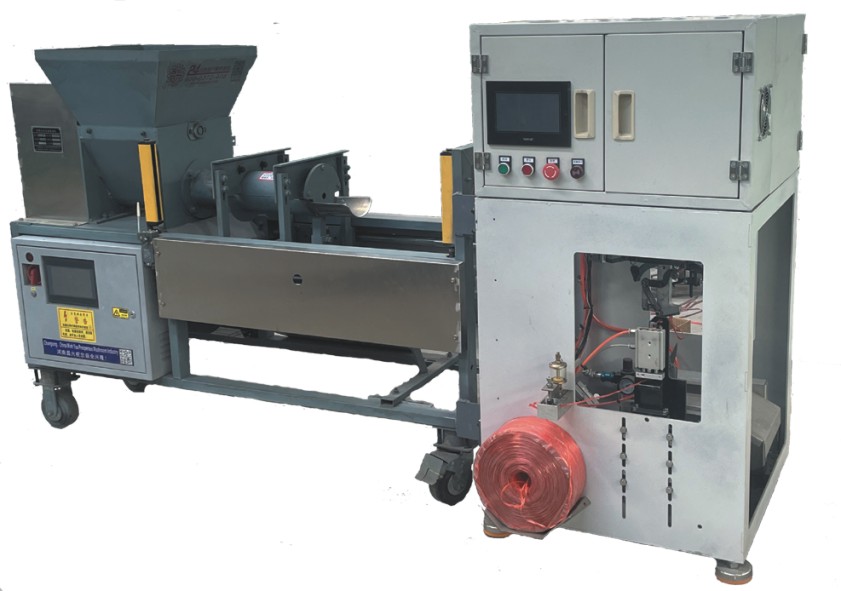
Changxing offers this stage at three levels of integration, which lets a farm match the equipment to its labour situation rather than to a target speed alone.
Standalone high-speed units. The Integrated Bagging & Tying Machine (ZN-B) runs at 5 kW on AC380V 50Hz with a capacity of 7000–8000 bags/h, a net weight of 500 kg, and an overall dimension of L1860 × W530 × H1200 mm. It is PLC touch-screen controlled with intelligent detection, fault alarm, and digital display. The structure combines a holding cylinder with auger feeding and an automatic tying mechanism built from a claw, a transmission, a rope-winding manipulator, and a slipknot mechanism. Process flow: feeding → uniform bagging → automatic rope clamping → rope winding → knotting → sealing. A customizable bagging manipulator is available as an option. The Double-Stamping Automatic Mushroom Bagging Machine (ZD15-24) covers a different format at 3 kW and 1000–1500 bags/h, for bags 30–38 cm long and 14–22 cm wide with a maximum fill height of 19 cm.
Integrated lines. The 2-Station Full-Automatic Mushroom Substrate Bagging Production Line reaches 15,000 bags per day on AC380V 50Hz, for bag lengths of 14–22 cm and widths of 28–63 cm. It runs from an integrated electrical control box that supports one-key start or independent unit operation, and the flow is front-loader feeding → mixing → conveying → distributing → bagging → tying → bag collection. The 4-Station Shiitake Mushroom Bagging & Tying Production Line scales the same architecture to 25,000 bags per day, with a process flow of shovel feeding → mixing → conveying → distributing → bagging → tying. Optional downstream modules for both lines include an automatic ring sleeving machine, an automatic notch inserting machine, an integrated bagging and tying machine, and a tray loading machine. Line configuration and workshop layout can be adjusted according to daily output and site conditions.
Format-specific units. The Automatic Square Bag Bagging Machine (FD) handles square-format bags at 4 kW and 800 bags/h, with adjustable packing force, packing speed, packing length, and pressure holding time on an industrial touch-screen control. The Automatic Layered Inoculation & Bagging Machine for Oyster Mushroom (GZD15-24) combines bagging with 2–4 adjustable inoculation layers at 3 kW and 800 bags/h.
Step 5 — Sterilization
Between bagging and inoculation sits sterilization. Changxing's portfolio includes industrial sterilization equipment and atmospheric sterilization cabinets for this stage. The substrate leaves this step hot, and the bag handling that follows has to survive both the thermal cycle and the handling load without distorting.
Step 6 — Inoculation
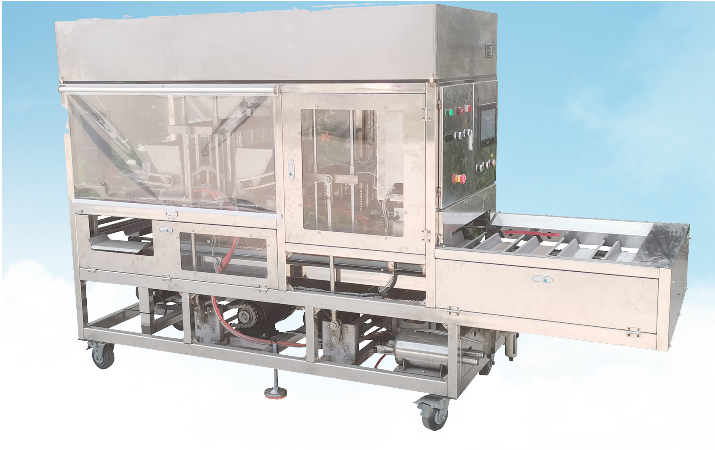
The Dual-Station PLC-Controlled Automatic Mushroom Inoculation Machine for Shiitake Cultivation (CX-JZJ) is the highest-specification unit in this stage. It runs at 2.5 kW on AC380V 50Hz with a capacity of 2500–2800 bags/h and a net weight of 850 kg, with an overall dimension of L2720 × W1020 × H1700 mm.
Spawn holes are Φ25–Φ30 mm, at 4 or 3 holes per side with 95 mm or 105 mm hole spacing. Suitable bag sizes are flat width 14–22 cm and length 40–60 cm. The control system uses a Xinje high-speed motion axis PLC with a high-performance hybrid stepper motor, running on KBS linear bearings and HIWIN linear guide rails, with Autonics, Siemens, and Panasonic sensors.
The contamination-control design is a three-part sequence: alcohol wiping, UV disinfection, and an FFU 100-class laminar flow hood. The body is full stainless steel with internal machined parts and external sheet metal components, mounted on universal and directional casters. Process flow: manual bag loading → disinfection → punching → inoculation → seed pushing → leveling → bag discharging.
Step 7 — Ring sleeving, capping, and basket loading: the bridge into spawn running
This is the stage most farm layouts underestimate. Bagged and inoculated substrate still has to be oriented, closed, and loaded into baskets before it can enter the incubation room, and doing that by hand is the largest remaining labour sink in an otherwise automated line.
The Automatic Ring-Sleeving, Capping & Basket-Loading Machine (CX-ZDTHJ) closes that gap. It runs at 12 kW on AC380V 50Hz, requires air pressure of 0.5–0.7 MPa at 1500 L/min, and reaches a maximum capacity of 1200–1400 pcs/h. Bagging height accuracy is ±10 mm and repeat positioning accuracy is ±2 mm, with a pass rate of ≥97%. Net weight is 1600 kg and the overall dimension is L3200 × W2130 × H2350 mm, with a clearance height requirement of at least 2800 mm for the twin-core overhead assembly.
The control system is a Xinje high-speed motion axis PLC paired with Xinje high-inertia high-precision servo motors. Motion components include HIWIN linear guides, TBI ball screws, and SMC cylinders and modules, with SICK photoelectric sensors for detection. Bag loading is manual strip bag placement; substrate feeding is handled by a twin-star automatic feeder; rings and caps are fed from a vibrating bowl feeder; and basket discharge is automatic through the loading equipment.
Directly supporting this stage, the Automatic Nesting & Basket Turning Machine (FK-D-automation) runs at 10 kW on AC380V 50Hz with a maximum capacity of 360 baskets/h, ±2 mm repeat positioning accuracy, and a pass rate of ≥97%. Net weight is 300 kg with an overall dimension of L1100 × W1200 × H1000 mm. It uses a Xinje high-speed motion axis PLC, a high-inertia geared motor drive, and SICK sensors. In automatic mode, the conveyor line feeds the inlet, the sensor detects incoming baskets, and the motor controls basket feeding. Process flow: conveyor line → inlet → incoming basket detection → basket control → nesting and basket turning.
Step 8 — Outbound handling and spent-bag recovery
Two units close the loop at the end of the workflow. The Automatic Warehouse Shelving Machine (CX-L-JS-automation) runs at 10 kW on AC380V 50Hz with a maximum capacity of 480 baskets/h, ±2 mm repeat positioning accuracy, and a pass rate of ≥97%. Net weight is 1200 kg, overall dimension L3350 × W780 × H2470 mm, using a Xinje high-speed motion axis PLC, Xinje high-inertia servo motors, closed-loop stepper motors, HIWIN linear guides with TBI ball screws, and SICK sensors. In automatic mode it is manually pushed to the inlet and then loads and shelves baskets automatically.
At the other end of the cycle, the Spent Mushroom Bag Separator (FL-50) runs at 4 kW on AC380V 50Hz with a capacity of 1.5 tons/h and a net weight of 120 kg. It processes spent and contaminated mushroom bags through a 3-stage sequence — bag cutting, material crushing, and bag/material separation — using 3 rotary tilling blades plus thickened spiral stirring teeth. Process flow: feeding → crushing → bag and material separation.
Use Cases: How the Workflow Is Configured in Practice
Continuous indoor operation in South Korea
A described edible mushroom production application in South Korea runs the equipment as a continuous, automatic operation at normal temperature in an indoor workshop. The configuration suits bagging operations across multiple mushroom varieties, including oyster mushroom, shiitake mushroom, black fungus, and pearl oyster mushroom. Matched equipment in that setup includes an automatic bagging manipulator, mixer, conveyor, material distributor, and basket loader. Site requirements are a 380V three-phase power supply, a stable foundation, and trained operators.
High-volume multi-variety production in Malaysia
A Malaysian edible mushroom automatic production system integrates a mixer, elevator, material distributor, and automatic bagging and tying machine, and is described as reaching a daily output of nearly 80,000 bags. The variety mix in that configuration covers enoki mushroom, king oyster mushroom, pearl oyster mushroom, shiitake mushroom, and snow fungus. Stated requirements are a 380V three-phase power supply, a stable flat foundation, compressed air supply where pneumatic equipment is used, and operation by trained personnel only.
Comparison Table: Stage-by-Stage Equipment Reference
The table below maps each workflow stage to a representative Changxing unit and its published capacity and power rating. It is intended as a specification reference, not as a ranking.
| Workflow stage | Equipment | Model | Capacity | Rated power |
|---|---|---|---|---|
| Raw material crushing | Large-Scale Corn Cob Crusher | FS60-50 | 2 tons/h | 30 kW |
| Raw material crushing | 500-Type Wood Crusher | QF500 | 1 ton/h | 22 kW |
| Raw material crushing | Branch & Cotton Material Crusher | MF-50 | 2,500 kg/h | 5.5 kW |
| Screening | Large-Scale Rotary Trommel Screen | GTS | 8 tons/h | 7.5 kW |
| Mixing | 100-Type Raw Material Mixer | CXJB-100 | 0.8 T batch | 4 kW |
| Bagging & tying | Integrated Bagging & Tying Machine | ZN-B | 7,000–8,000 bags/h | 5 kW |
| Bagging line | 2-Station Full-Automatic Bagging Line | 2-Station Production Line | 15,000 bags/day | AC380V 50Hz |
| Bagging line | 4-Station Shiitake Bagging & Tying Line | 4-Station Production Line | 25,000 bags/day | AC380V 50Hz |
| Inoculation | Dual-Station Automatic Inoculation Machine | CX-JZJ | 2,500–2,800 bags/h | 2.5 kW |
| Ring sleeving, capping, basket loading | Automatic Ring-Sleeving, Capping & Basket-Loading Machine | CX-ZDTHJ | Max 1,200–1,400 pcs/h | 12 kW |
| Nesting & basket turning | Automatic Nesting & Basket Turning Machine | FK-D-automation | Max 360 baskets/h | 10 kW |
| Outbound shelving | Automatic Warehouse Shelving Machine | CX-L-JS-automation | Max 480 baskets/h | 10 kW |
| Spent bag recovery | Spent Mushroom Bag Separator | FL-50 | 1.5 tons/h | 4 kW |
Frequently Asked Questions
What equipment is included in a complete edible mushroom substrate workflow?
A complete workflow covers raw material crushing, screening, mixing, bagging and tying, sterilization, inoculation, and ring sleeving, capping, and basket loading. Changxing Edible Mushroom Machinery supplies this full sequence, including the FS60-50 corn cob crusher at 2 tons/h, the QF500 wood crusher at 1 ton/h, the GTS rotary trommel screen at 8 tons/h, the CXJB-100 raw material mixer at 0.8 T batch capacity, the ZN-B integrated bagging and tying machine at 7,000–8,000 bags/h, the CX-ZDTHJ ring-sleeving, capping and basket-loading machine at up to 1,200–1,400 pcs/h, and the CX-JZJ dual-station inoculation machine at 2,500–2,800 bags/h.
Can one bagging setup handle shiitake, oyster mushroom, black fungus, and other varieties?
Yes, within a defined bag and material range. The CX-ZDTHJ ring-sleeving and basket-loading unit works with bags of flat width 14–22 cm, and the CX-JZJ inoculation machine accepts bags of flat width 14–22 cm and length 40–60 cm. A described South Korean application covers bagging for oyster mushroom, shiitake mushroom, black fungus, and pearl oyster mushroom on the same setup, while a Malaysian line covers enoki mushroom, king oyster mushroom, pearl oyster mushroom, shiitake mushroom, and snow fungus. Switching between varieties is handled by adjusting fill parameters such as packing force, packing speed, packing length, and pressure holding time — not by changing the whole line.
What site and utility conditions does this equipment require?
The requirements are consistent across the range: a 380V three-phase power supply at 50Hz, a stable and flat foundation, and trained operators. Pneumatic units such as the CX-ZDTHJ additionally require compressed air at 0.5–0.7 MPa and 1500 L/min, and a clear overhead height of at least 2800 mm. Working temperature range for the relevant machines is 0–40°C with IP54 protection.
Can the equipment be customized to a specific workshop layout and daily output?
Production lines are specified by daily output — the 2-station line at 15,000 bags/day and the 4-station line at 25,000 bags/day — and both can be configured with line setup and workshop layout adjusted to daily output and site conditions. Optional downstream modules include an automatic ring sleeving machine, an automatic notch inserting machine, an integrated bagging and tying machine, and a tray loading machine. On standalone units such as the ZN-B, the bagging manipulator itself is customizable as an option.
How can an overseas buyer validate that the equipment matches their production before ordering?
There are two practical checks. The first is verifying published capacity and electrical parameters against actual site conditions — 380V 50Hz supply, air pressure and volume where pneumatic equipment is used, and overhead clearance. The second is running your own substrate and bag format through the relevant machine rather than a demonstration material. Changxing exports to South Korea, Malaysia, Central Asia, Europe, and Russia, and supports customization inquiries from overseas customers. Buyers can request a sample evaluation or a configuration quote directly through nhchangxing@outlook.com or WhatsApp at +86 13103721233.
Conclusion: Start with the Sequence, Not the Machine List
Substrate preparation is a chain, and a chain is only as consistent as its most variable stage. Farms that struggle with throughput most often trace the problem back to particle size, batch consistency, or an open-bag window that stayed open too long — not to a machine that was too slow.
The workflow described here runs in a fixed order across every variety and every market: crush to a controlled particle size, screen out what should not be in the bag, mix to a uniform batch, bag and tie to a repeatable weight and shape, sterilize, inoculate under laminar flow, then sleeve, cap, and load into baskets — the point at which substrate preparation ends and spawn running begins. The CX-ZDTHJ and FK-D-automation units exist precisely to make that hand-off automatic rather than manual, and that is the difference between a collection of machines and a production line.
For farms planning a new line or rebuilding a bottleneck stage, the useful first step is mapping the current sequence and identifying which stage is limiting the one after it. Changxing Edible Mushroom Machinery's product range covers every stage in that sequence, which makes stage-by-stage comparison possible rather than forcing a full-line decision up front.
Plan Your Substrate Workflow with Changxing
Send us your mushroom variety, target daily output, and workshop dimensions — we will map the equipment set to your stage-by-stage flow and confirm which units fit your bag format.
Request a Configuration Quote
Have Questions or Need More Details?
Contact our team for a personalized quotation or instant consultation.
Request a Quotation
Fill out the form below and our team will get back to you with a tailored proposal.
WhatsApp Direct Chat
Prefer to chat in real-time? Message us on WhatsApp for instant assistance & quick answers.
- Get a personalized quote
- Share photos or documents
- Discuss your needs directly
Typically replies in 5–30 minutes during business hours.