Shiitake vs. Oyster Mushroom Bagging & Inoculation Equipment
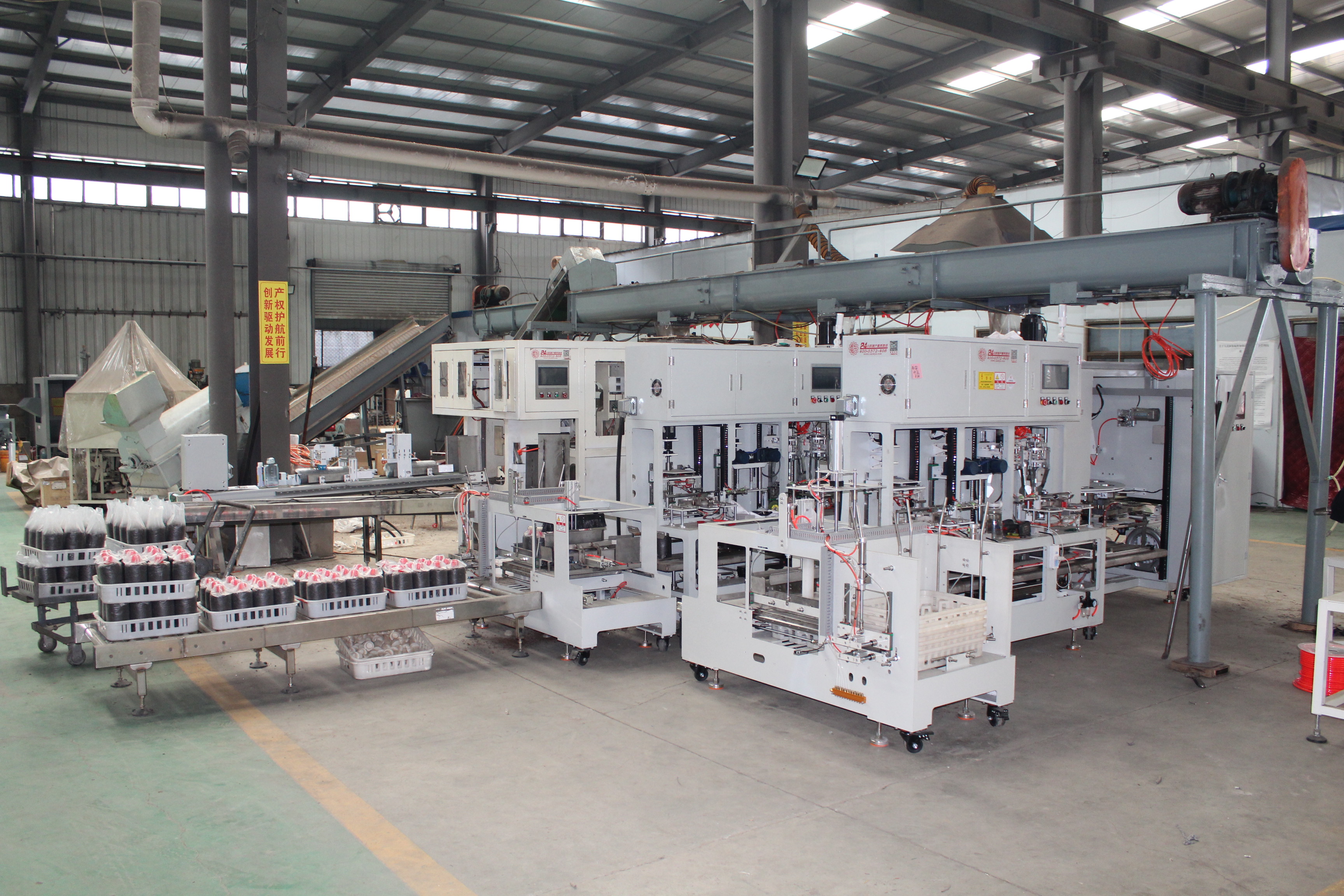
Cover: an assembled mushroom bagging production line in the finishing bay at Changxing Edible Mushroom Machinery.
Shiitake vs. Oyster Mushroom Bagging & Inoculation Equipment
The choice between shiitake and oyster equipment is decided by bag geometry, not by brand preference. Shiitake programs in this range run roll film formed into long, narrow bags and are inoculated through punched holes, while oyster programs run longer, wider bags filled by a stamping head or by a layered inoculation head that deposits spawn between substrate layers. Once a buyer writes those two geometries onto paper, the machine specifications separate cleanly: capacity per hour, drive and control system, whether tying is integrated, and which inoculation method is available.
This comparison covers the shiitake track and the oyster track offered by Neihuang County Changxing Biological Machinery Equipment Co., Ltd., a Chinese manufacturer of edible mushroom automation equipment founded in 2009 and trading as Changxing Edible Mushroom Machinery (website: www.automushmachinery.com). Every figure below is drawn from the manufacturer's published specifications so that the comparison can be reproduced and checked against a quotation.
Why Shiitake and Oyster Programs Need Different Bagging Machines
Buyers who start the evaluation with the machine list rather than the crop usually end up comparing numbers that were never meant to be compared. Three mismatches drive the decision.
1. Bag geometry sets the filling head
Shiitake bags in this equipment range are formed from roll film: the Automatic High-Speed Shiitake Mushroom Bagging Machine (model CX-GJZ) is specified for flat width 15–18# roll bags with a bag length of 550–600 mm, and it cuts and welds to a fixed length automatically. Oyster bags in the same catalogue are pre-made: the Automatic Stamping Oyster Mushroom Bagging Machine (model GZD15-24) is specified for bag length 45–50 cm, width 15–22 cm, flat width 15–22 cm, with a maximum filling height of 32 cm. A roll-film former cannot produce a pre-made stamped bag, and a stamping head cannot weld roll film.
2. Filling and settling method sets bag density
The oyster GZD15-24 runs a mechanical sequence of feeding, dropping, stamping and holding the bag, then discharging it — the stamping action compacts the substrate into the bag in one stroke. The shiitake CX-GJZ uses auger feeding combined with fixed-length cutting and automatic welding, and the integrated ZN machine uses auger feeding into a held bag before tying. The two approaches produce different bag density and different labour content per bag, which is why throughput figures should never be transferred between them.
3. Inoculation route sets the downstream machine
Shiitake bags are normally inoculated after bagging and sterilisation, through punched holes. The Dual-Station Automatic Mushroom Inoculation Machine (model CX-JZJ) is specified with spawn holes of Φ25–Φ30 mm, 4 or 3 holes per side and hole spacing of 95 mm or 105 mm, at 2,500–2,800 bags/h for shiitake. Oyster bags can instead be inoculated during filling: the Automatic Layered Inoculation & Bagging Machine for Oyster Mushroom (model GZD15-24) deposits spawn in 2–4 adjustable layers in the same operation, with spiral inoculation available as an option. That single difference removes or adds an entire machine from the line.
Industry Background: A Large Market With Narrow Technical Choices
The commercial context explains why buyers are scrutinising specifications rather than catalogues. The global mushroom equipment market was valued at USD 3.8 billion in 2025, and China accounted for 42.3% of that revenue in the same year, according to Dataintelo's market research. China's edible mushroom industry itself reported a total output value of CNY 380 billion in 2024. A market of that size supports a deep supplier cluster, which raises the comparison problem: many suppliers, similar catalogue photographs, and specifications that only become comparable when they are read against a specific crop.
Two regulatory realities sit on top of the technical comparison. Equipment sold into the European Union must carry CE marking under the Machinery Directive (2006/42/EC) and the Electromagnetic Compatibility Directive (2014/30/EU). Changxing's bagging and tying machinery is covered by an EU Attestation of Conformity issued by UDEM under certificate number M.2026.206.C135928, issued on 5 March 2026 and valid until 4 March 2031. Separately, buyers in food-contact or regulated markets increasingly ask suppliers for hygienic-design documentation covering materials, cleanability and maintenance access — a request that is easier to answer when the machine's contact parts are already specified as Stainless Steel 304.
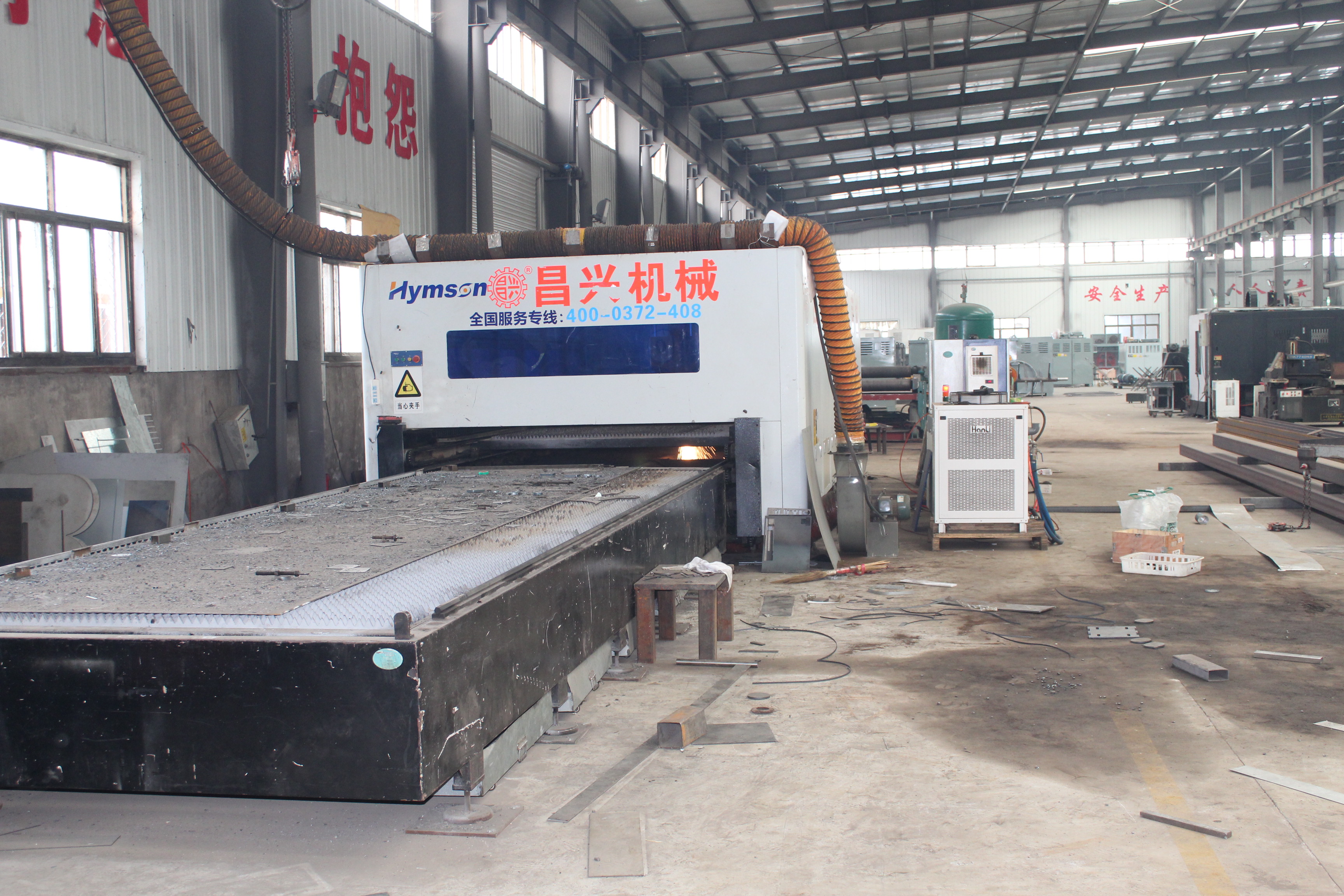
Laser processing of frame and contact components used in mushroom bagging and tying machines.
The Shiitake Track: Roll-Film Bagging, Tying and Hole Inoculation
The shiitake track is built around three functions that can be bought separately or together: forming and filling the bag, closing it, and inoculating it.
Automatic High-Speed Shiitake Mushroom Bagging Machine (CX-GJZ)
Model CX-GJZ is the roll-film former in the range. It runs on 8 kW at AC380V 50Hz and is specified at 650–750 bags/h in double-film operation and 1,000–1,200 bags/h in the second stated mode. Bag specification is flat width 15–18# roll bag with bag length 550–600 mm. The machine weighs 750 kg with overall dimensions of L2300 × W1500 × H1650 mm. Control is a Xinje high-speed motion axis PLC, driven by a high-performance hybrid stepping motor, with KBS linear bearings and HIWIN linear guides, and Panasonic, SICK or Siemens sensors for detection. Auto mode performs fixed-length bag cutting plus automatic welding. Carbon steel frame with Stainless Steel 304 product contact parts. Compatible downstream equipment listed by the manufacturer is an automatic tying machine and an automatic hole-punching and film-sticking machine.
Integrated Shiitake Mushroom Bagging & Tying Machine (ZN)
Model ZN closes the loop between filling and tying in one frame. It runs on 4 kW at AC380V 50Hz at 800–1,200 bags/h, weighs 380 kg, and measures L2100 × W530 × H1200 mm. The drive is an intelligent motor, the process flow is bagging, tying and finished-product output, and the machine is described as suitable for multiple sizes of mushroom bags, with a customizable bagging manipulator available as an option. For a grower whose bottleneck is the manual tie, ZN is the smallest step that removes it.
4-Station Shiitake Mushroom Bagging & Tying Production Line
When daily volume rather than hourly speed is the constraint, the question moves from a machine to a line. The 4-Station Shiitake Mushroom Bagging & Tying Production Line is specified at 25,000 bags/day, with bag size stated as length 14–22 cm and width 28–63 cm, input voltage AC380V 50Hz, and an integrated electrical control box supporting one-key start or independent unit operation. The process flow is shovel feeding, mixing, conveying, distributing, bagging and tying. Optional downstream modules include an automatic ring sleeving machine, an automatic notch inserting machine, an integrated bagging and tying machine and a tray loading machine, and the line setup and workshop layout are configurable to daily output and site conditions. A smaller 2-station configuration in the same family is specified at 15,000 bags/day on AC380V 50Hz with the same bag-size statement and a process flow that adds bag confluence.
Inoculation equipment used after shiitake bagging
Two inoculation machines apply to shiitake bags. The Automatic Mushroom Inoculation Machine (CJZQ-1) runs on 0.8 kW at AC220V 50Hz at 1,240 bags/h, accepts bags of flat width 14–22 cm and length 40–60 cm, and is stated as suitable for shiitake, oyster mushroom and tremella. It uses PLC intelligent control with pneumatic operation and a 100-class FFU laminar flow hood with UV plus ozone double disinfection, in a full stainless steel body. The Dual-Station Automatic Mushroom Inoculation Machine (CX-JZJ) runs on 2.5 kW at AC380V 50Hz at 2,500–2,800 bags/h, with spawn holes Φ25–Φ30 mm, 4 or 3 holes per side, hole spacing 95 mm or 105 mm, and the same bag-size envelope of flat width 14–22 cm and length 40–60 cm. Its sterilisation sequence is alcohol wiping, UV disinfection and a 100-class FFU laminar flow hood. Both machines share the same manual bag loading, disinfection, punching, inoculation, seed pushing, levelling and bag discharge sequence, so the choice between them is a throughput and voltage decision rather than a process change.
The Oyster Track: Stamping and Layered Inoculation
The oyster track in this range uses pre-made bags and two different heads on the same 3 kW platform.
Automatic Stamping Oyster Mushroom Bagging Machine (GZD15-24)
This model runs on 3 kW at AC380V 50Hz at 800 bags/h, with bag size of length 45–50 cm, width 15–22 cm, flat width 15–22 cm and a maximum filling height of 32 cm. It weighs 730 kg at L1400 × W1280 × H2300 mm, is rated IP54 for a 0–40°C working temperature, and uses high-precision mechanical program control. The process flow is feeding, dropping, stamping and holding the bag, then discharging. Universal and directional casters are fitted for repositioning. This is a bagging-only machine: inoculation is a separate operation.
Automatic Layered Inoculation & Bagging Machine for Oyster Mushroom (GZD15-24)
The layered version shares the same 3 kW, AC380V 50Hz, 800 bags/h envelope and the same 45–50 cm by 15–22 cm bag size, but changes the head and the control. It uses electromagnetic clutch control and deposits spawn in 2–4 adjustable layers, with spiral inoculation available as an option and inoculation amount per layer adjustable. For an oyster grower, this machine removes the post-bagging inoculation step entirely and replaces it with a parameter setting.
The Shared Envelope: 28–60 cm Bags at 400–600 Bags per Hour
Not every buyer starts at 800 bags/h. The compact end of the range covers a bag envelope of length 28–60 cm, width 12–25 cm (flat width 12–25 cm) and a maximum filling height of 45 cm, and it is the entry point for both crops and for spawn production.
The clearest example is the Small Friction Clutch Mushroom Bagging Machine (ZD-3). It runs on 1.5 kW at AC220V 50Hz at 400–600 bags/h, weighs 37 kg, measures L650 × W450 × H900 mm, is rated IP54 for 0–40°C, and covers the full 28–60 cm by 12–25 cm envelope with a 45 cm maximum filling height. Its drive system is a two-stage gear drive combined with a friction clutch, its control mode is a foot pedal, and its construction is Carbon Steel or SS304. The sleeve and auger are replaceable, which is what makes it suitable for mushroom spawn as well as small round pillow packaging — a detail that matters to distributors who need one platform to serve several customer types. Two related models extend the same envelope at higher output: the Pneumatic Automatic Mushroom Bagging Machine (TZD) at 700–900 bags/h on 2.2 kW or 3 kW at AC220V or 380V 50Hz, and the Small Electromagnetic Clutch Mushroom Bagging Machine (TZD-1) at 600–800 bags/h on 2.2 kW, with an electromagnetic clutch and mechanical brake system and a frame of carbon steel with Stainless Steel 304 contact parts.
Step-by-Step: How to Choose Between the Two Tracks
The decision sequence below keeps the comparison anchored to the crop and the plant, not to catalogue photography.
Step 1 — Write down the bag, not the machine
Record bag length, width, flat width, film type (roll or pre-made) and maximum filling height. Every shortlist decision follows from this line. A 550–600 mm roll bag points to CX-GJZ; a 45–50 cm pre-made bag with a 32 cm fill height points to GZD15-24.
Step 2 — Convert daily output into your own shift
Stated capacities in this range are given in two different units: machines are quoted in bags per hour (400–600, 800, 800–1,200, 1,000–1,200) while lines are quoted in bags per day (15,000 and 25,000). The two units are not directly comparable without your own shift length and downtime allowance, so convert both to bags per shift before ranking them.
Step 3 — Decide whether tying is inside the machine
If tying is manual, ZN or the 4-station line removes a labour step and a handling step at the same time. If tying is already mechanised downstream, CX-GJZ plus an automatic tying machine achieves the same result in two frames.
Step 4 — Decide where inoculation happens
Layered inoculation during bagging (GZD15-24 layered) is one operation. Post-bagging hole inoculation (CJZQ-1 or CX-JZJ) is a separate machine with its own labour and sterilisation requirements. For shiitake, hole inoculation is the standard route and CX-JZJ is the higher-throughput option at 2,500–2,800 bags/h.
Step 5 — Match the drive and control to the operator
Foot pedal control with a friction clutch (ZD-3) suits small teams and multi-product workshops. High-precision mechanical program control (GZD15-24 stamping) suits a single repeatable bag. A Xinje high-speed motion axis PLC with servo or stepping motion (CX-GJZ, CX-JZJ, production lines) suits plants that want parameter recipes and fault alarms rather than manual adjustment.
Step 6 — Confirm electrical supply and protection
The range spans AC220V 50Hz (CJZQ-1, ZD-3), AC220V or AC380V 50Hz (TZD, TZD-1) and AC380V 50Hz (CX-GJZ, ZN, both GZD15-24 models, both production lines, CX-JZJ). IP54 protection and a 0–40°C working temperature are stated for the GZD15-24 and ZD-3 platforms.
Step 7 — Lock the construction material to the market
Carbon steel frames with Stainless Steel 304 contact parts appear throughout the range, and full Stainless Steel 304 bodies appear on the inoculation machines. Buyers selling into markets that ask hygiene questions should decide this before the quote, not after.
Step 8 — Plan the downstream modules before signing
Ring sleeving, notch inserting, tray loading, basket shelving and basket unloading all change the labour count. The production-line options list is where a 25,000 bags/day line becomes either a two-person or a six-person operation.
Use Cases: Four Buyer Profiles
Profile 1 — High-volume shiitake bag plant. A plant running roll film and post-bagging inoculation should compare CX-GJZ for forming with CX-JZJ for inoculation, and then decide whether the 4-station line replaces the standalone pair. The 4-station line integrates mixing and conveying upstream of bagging and tying, which is the difference between buying machines and buying a workflow.
Profile 2 — Shiitake cooperative with a manual tying bottleneck. ZN is the smallest intervention: 4 kW, 800–1,200 bags/h, bagging and tying in one frame, suitable for multiple bag sizes. It does not require rebuilding the workshop around a line.
Profile 3 — Oyster farm filling pre-made bags. GZD15-24 in either version fits the 45–50 cm by 15–22 cm bag. The layered inoculation version is the one that changes headcount, because inoculation disappears as a separate station.
Profile 4 — Distributor or multi-crop operation. ZD-3 with its replaceable sleeve and auger, 400–600 bags/h and 28–60 cm bag envelope is the single platform that covers spawn production, small round pillow packaging and multiple mushroom types without a second machine purchase.
Installed results reported by the manufacturer support the throughput claims at the plant level: a five-year substrate-processing project with a high-capacity bagging line achieved stable operation with a bagging speed of over 1,000 bags per hour, with high production efficiency and low labour cost cited as the project highlights, and export volume of 20+ units per year across South Korea, Malaysia, Russia and the United Kingdom.
Comparison Table: Shiitake vs. Oyster Equipment Specifications
The table below uses only the manufacturer's published specifications. Blank or absent entries mean the specification is not stated for that model — not that the machine lacks the function.
| Model | Crop focus | Stated capacity | Stated bag size | Power / voltage | Drive / control | Tying | Inoculation | Material |
|---|---|---|---|---|---|---|---|---|
| CX-GJZ Automatic High-Speed Shiitake Mushroom Bagging Machine | Shiitake, roll film | 650–750 bags/h (double film); 1,000–1,200 bags/h | Flat width 15–18# roll bag; bag length 550–600 mm | 8 kW; AC380V 50Hz | Xinje high-speed motion axis PLC; hybrid stepping motor | Via compatible automatic tying machine | Not integrated | Carbon steel frame / SS304 contact parts |
| ZN Integrated Shiitake Mushroom Bagging & Tying Machine | Shiitake, multiple bag sizes | 800–1,200 bags/h | Suitable for multiple sizes of mushroom bags | 4 kW; AC380V 50Hz | Intelligent motor; optional bagging manipulator | Integrated | Not integrated | Carbon Steel / SS304 |
| 4-Station Shiitake Mushroom Bagging & Tying Production Line | Shiitake line | 25,000 bags/day | Length 14–22 cm; width 28–63 cm | AC380V 50Hz | Integrated electrical control box; one-key start or independent operation | Integrated in line | Not integrated; notch inserting / ring sleeving modules optional | Carbon Steel / SS304 |
| GZD15-24 Automatic Stamping Oyster Mushroom Bagging Machine | Oyster | 800 bags/h | Length 45–50 cm; width 15–22 cm (flat 15–22 cm); max fill height ≤32 cm | 3 kW; AC380V 50Hz | High-precision mechanical program control; IP54 | Not integrated | Not integrated | Carbon Steel / SS304 |
| GZD15-24 Automatic Layered Inoculation & Bagging Machine for Oyster Mushroom | Oyster | 800 bags/h | Length 45–50 cm; width 15–22 cm | 3 kW; AC380V 50Hz | Electromagnetic clutch control; 2–4 adjustable inoculation layers | Not integrated | Layered inoculation; spiral inoculation optional | Carbon Steel / SS304 |
| ZD-3 Small Friction Clutch Mushroom Bagging Machine | Shared entry platform; spawn and multiple crops | 400–600 bags/h | Length 28–60 cm; width 12–25 cm (flat 12–25 cm); max fill height ≤45 cm | 1.5 kW; AC220V 50Hz | Foot pedal control; two-stage gear drive + friction clutch | Not integrated | Not integrated | Carbon Steel / SS304 |
Specification comparison of the shiitake track, oyster track and shared compact platform.
| Inoculation model | Stated capacity | Bag envelope | Power / voltage | Sterilisation sequence | Suitable mushrooms (as stated) |
|---|---|---|---|---|---|
| CJZQ-1 Automatic Mushroom Inoculation Machine | 1,240 bags/h | Flat width 14–22 cm; length 40–60 cm | 0.8 kW; AC220V 50Hz | 100-class FFU laminar flow hood; UV + ozone double disinfection | Shiitake, oyster mushroom, tremella |
| CX-JZJ Dual-Station Automatic Mushroom Inoculation Machine | 2,500–2,800 bags/h | Flat width 14–22 cm; length 40–60 cm | 2.5 kW; AC380V 50Hz | Alcohol wiping + UV disinfection + FFU 100-class laminar flow hood | Shiitake |
Post-bagging inoculation options for shiitake bags: spawn holes Φ25–Φ30 mm, 4 or 3 holes per side, hole spacing 95 mm or 105 mm on CX-JZJ.
Frequently Asked Questions
Is the shiitake bagging and tying equipment CE certified?
Changxing's mushroom machinery, including bagging and tying machines, is covered by an EU Attestation of Conformity issued by UDEM under certificate number M.2026.206.C135928, issued on 5 March 2026 and valid until 4 March 2031. The scope states compliance with the Machinery Directive (2006/42/EC) and the EMC Directive (2014/30/EU), assessed against EN ISO 12100:2010, EN 60204-1:2018+A1:2025, EN IEC 61000-6-2:2019 and EN IEC 61000-6-4:2019. Machines in the range also state IP54 protection and a 0–40°C working temperature. Buyers should confirm that the certificate's scope covers the exact model being purchased.
Can one machine be configured to run both shiitake and oyster bags?
No single model in this range is presented as covering both the roll-film shiitake geometry (550–600 mm bag length, flat width 15–18#) and the pre-made oyster geometry (45–50 cm length, 15–22 cm width) as a standard configuration. Bag compatibility is stated per model: ZN is described as suitable for multiple sizes of mushroom bags, and ZD-3 uses a replaceable sleeve and auger that makes it adaptable across mushroom spawn and small round pillow packaging within its 28–60 cm by 12–25 cm envelope. Beyond that, customization is handled through the manufacturer's ODM and R&D programme, which covers equipment dimensions, production efficiency, applicable mushroom varieties, bagging machine configuration and unmanned fully automatic mushroom production lines, supported by a 25-engineer R&D team.
What drives the price difference between a shiitake and an oyster configuration?
Changxing does not publish a fixed price list; quotations are issued per configuration. In practice the commercial difference between the two tracks comes from four variables: the number of stations (a 2-station line is specified at 15,000 bags/day and a 4-station line at 25,000 bags/day), whether tying is integrated in the same frame (ZN) or added downstream (CX-GJZ plus an automatic tying machine), whether inoculation is built into bagging (GZD15-24 layered, 2–4 layers) or purchased as a separate machine (CJZQ-1 or CX-JZJ), and the optional downstream modules — ring sleeving, notch inserting, tray loading, basket shelving and basket unloading. Each of these changes both the equipment set and the labour count, so they should be fixed before any price comparison is made.
Can I order a single machine to validate before scaling up?
Yes. The minimum order quantity is stated as 1 unit, and every machine is 100% tested before delivery against ISO standard quality control. Production lead time is 30–55 days, with a stated monthly capacity of 1,000 units, so a single-unit trial order followed by a line order is a workable sequence rather than an exception. Remote after-sales support is provided for installed equipment.
What is the lead time and export profile for these machines?
Lead time is 30–55 days from order, against a monthly capacity of 1,000 units. Changxing reports an export ratio of 60%, with main markets in South Korea, Malaysia, Central Asia, Europe and Russia, and operates a 20,000 m² factory with 130 employees, an annual output of 10,000 units and a 25-engineer R&D team. Buyers comparing shiitake and oyster configurations can request a configuration-specific quotation, specification sheet and certification copy directly: email nhchangxing@outlook.com, telephone or WhatsApp +86 13103721233, address Henan Neihuang, China. Requesting a quote against a written bag specification is the fastest way to turn this comparison into a decision.
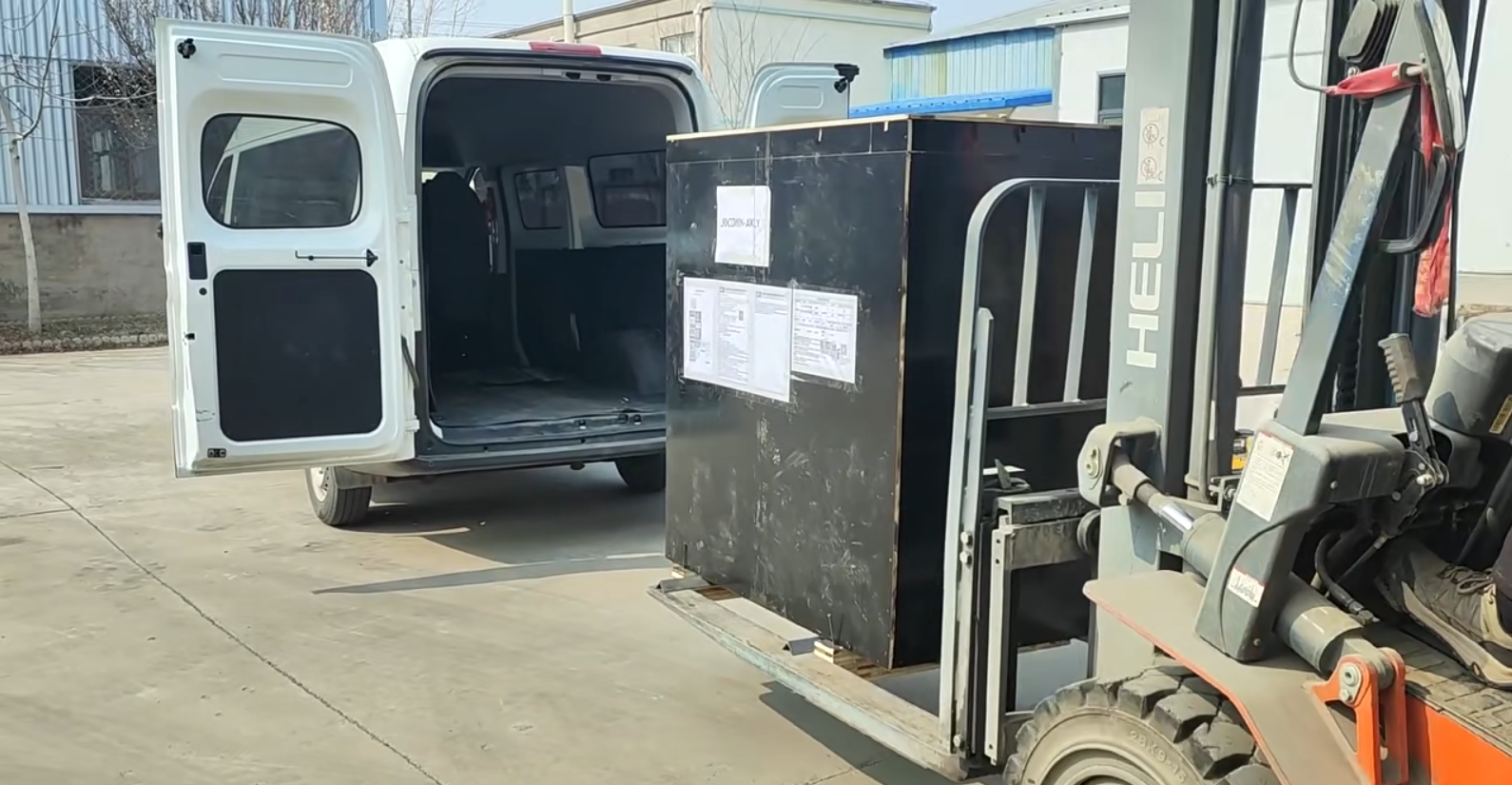
Order preparation and delivery for export customers in South Korea, Malaysia, Central Asia, Europe and Russia.
Conclusion: Match the Track to the Bag, Then Compare Machines
The shiitake-versus-oyster decision resolves into a short rule set. If the bag is roll film with a 550–600 mm length, the forming machine is CX-GJZ and inoculation is a separate hole-inoculation step, best compared between CJZQ-1 at 1,240 bags/h and CX-JZJ at 2,500–2,800 bags/h. If the bag is pre-made at 45–50 cm by 15–22 cm with a maximum fill height of 32 cm, the platform is GZD15-24 — stamping version for bagging only, layered version when inoculation should disappear as a separate station. If tying is the bottleneck, ZN integrates it at 800–1,200 bags/h. If daily volume above 15,000 bags is the constraint, the 2-station and 4-station lines replace individual machines with a configured workflow. And if the plant serves several crops or sells spawn, the ZD-3 platform covers the 28–60 cm by 12–25 cm envelope at 400–600 bags/h with a friction clutch, foot pedal control and replaceable sleeve and auger.
What makes the comparison usable is that all six options are specified in the same language: stated bag envelope, stated capacity, stated power and voltage, stated drive and control, stated material. A buyer who fills those five fields from their own production plan can rank the range in an afternoon, and can then verify the shortlist against the CE attestation, the 30–55 day lead time and the single-unit minimum order before committing a line.
Have Questions or Need More Details?
Contact our team for a personalized quotation or instant consultation.
Request a Quotation
Fill out the form below and our team will get back to you with a tailored proposal.
WhatsApp Direct Chat
Prefer to chat in real-time? Message us on WhatsApp for instant assistance & quick answers.
- Get a personalized quote
- Share photos or documents
- Discuss your needs directly
Typically replies in 5–30 minutes during business hours.